
Extensive Reading with Read2Fluent: Learn a Language Through Short Stories
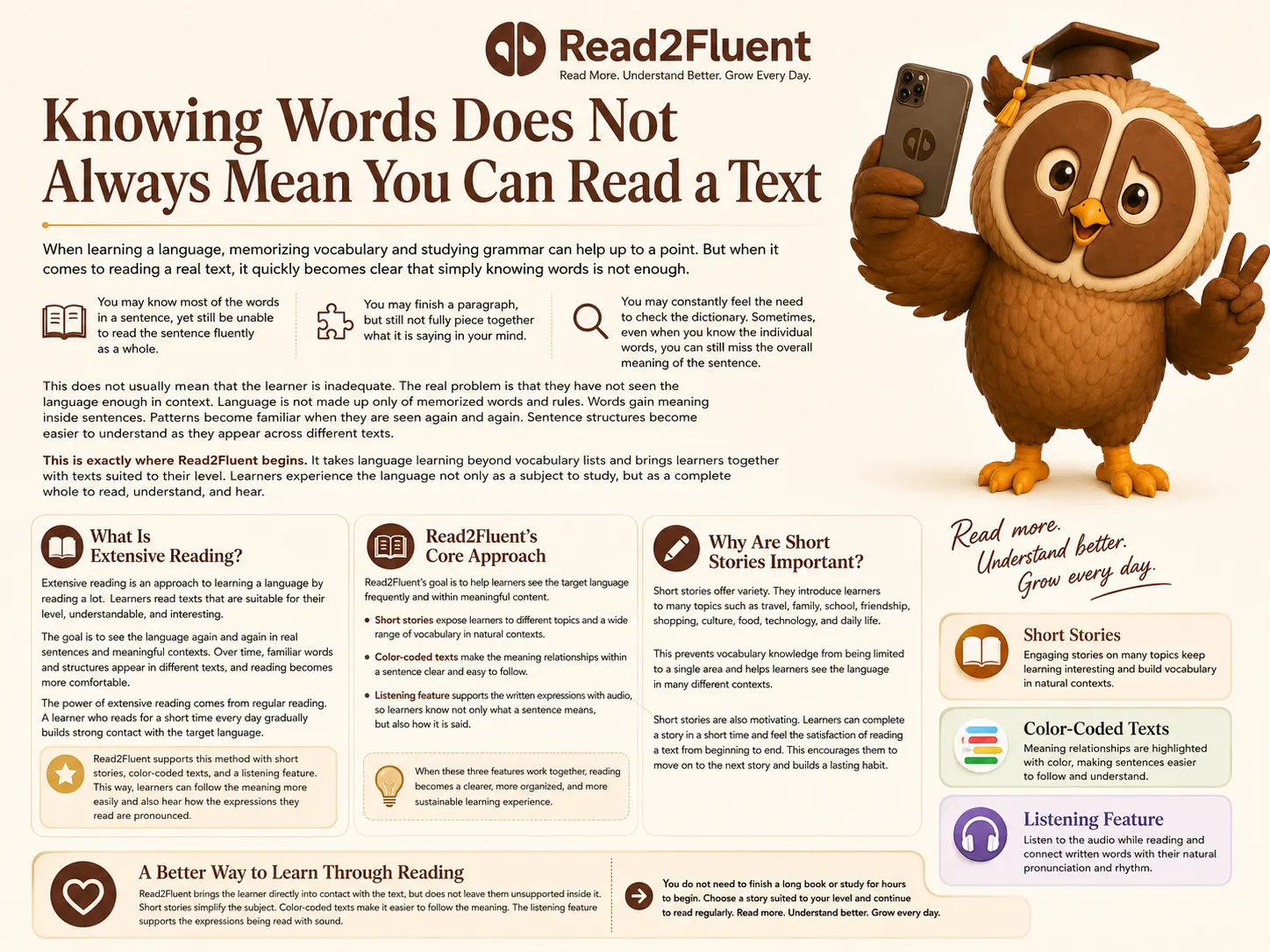
01Knowing words is not the same as being able to read
Memorizing vocabulary and studying grammar gets you somewhere when you learn a language. But the moment you try to read a real text, it becomes clear that knowing words alone is not enough.
You know most of the words in a sentence, yet you cannot read the whole sentence fluently. You finish a paragraph, but you cannot quite hold what it said in your head. You feel the constant pull of the dictionary. Sometimes you know every word and still miss what the sentence means.
This usually does not mean the learner is failing. The real issue is that the language has not been seen in enough context. A language is not just memorized words and rules. Words gain meaning inside sentences. Patterns become familiar only when they appear again and again. Sentence structures get easier as you meet them in different texts.
To truly learn a language is to see it enough times, in the right kind of context.
Read2Fluent starts from exactly this point. It moves language learning beyond word lists and puts the learner in front of texts that match their level. The language stops being a subject to study and becomes something to read, understand and hear as a whole.
02What is extensive reading?
Extensive reading is an approach to learning a language by reading a lot. The learner reads texts that are understandable, interesting and matched to their level. The goal is not to decode every single word or to dissect every sentence grammatically. The goal is to see the language again and again inside real sentences and meaningful contexts.
In this approach the learner tries to follow the overall meaning of the text. Unknown words may appear, but the reading flow is not interrupted at every one of them. Over time the same words, similar expressions and familiar sentence structures show up in different texts. Reading becomes easier through this repetition.
The power of extensive reading does not come from a single intense session. It comes from regular reading. A learner who reads for a short time every day builds a strong contact with the target language. Words feel more familiar, sentences are understood faster, and the structure of the language is noticed in a more natural way.
Read2Fluent supports this method with short stories, color-coded text and a listening feature. The learner does not just read text; they follow meaning more easily and also hear how the expressions actually sound.
03How Read2Fluent approaches it
Read2Fluent offers a language learning experience built around extensive reading. The aim is to let the learner see the target language in large amounts and inside meaningful content. But it does not leave this as an ordinary reading experience.
Three pillars support the learner inside Read2Fluent:
- Short stories bring the learner into contact with different topics. Inside a single long text you stay close to the same word field; across different short stories you meet different situations, different people and different groups of words.
- Color-coded text makes the meaning relations inside a sentence easier to see. You can follow which expression in the target language matches which meaning in your own language.
- The listening feature supports the written text with sound. You hear not only what a sentence means but also how it is spoken.
When these three work together, reading turns into a more understandable, more organized and more sustainable learning experience.
04Why short stories matter
It is not by accident that Read2Fluent puts so much weight on short stories. Short stories give a powerful advantage for language learning: variety.
Reading a single long story can of course be useful. The learner follows the characters, the events and the world of the story. But a long text usually revolves around one topic area:
- A detective story leans on words about crime, suspicion, investigation and mystery.
- A romance leans on emotion, relationships and everyday conversation.
- A business text relies on meetings, decisions, planning and professional communication.
All of these are valuable. But in real life language does not stay inside one topic.
In daily life you shop one day, ask for directions another day, make plans with a friend, talk with your family, go into a job interview, order food or describe a moment from a trip. Each situation calls for different words and different ways of expressing things.
Read2Fluent's short stories bring the learner into contact with this variety. One story may carry travel vocabulary, while another may center on family relationships, school life, friendship, shopping, culture, food, technology, city life or daily routines. The learner sees the language without being trapped inside a single story world, and vocabulary building becomes more balanced and more natural.
Finishing a short story gives the feeling of "I read a whole text in this language." In language learning, that small sense of achievement is everything.
Another important side of short stories is motivation. Long texts can look exhausting, especially for beginner and intermediate learners. The learner may give up before even starting. A short story is a more reachable goal and pushes the learner toward the next one. Over time reading stops being a forced task and turns into a sustainable habit.
05What color-coded text is for
When reading in a foreign language, what slows the learner down is not always unknown words. Sometimes most of the words are familiar, but the sentence structure feels tangled. The learner struggles to follow which part corresponds to which meaning.
The reason is that languages do not operate in the same order. A meaning placed at the start of a sentence in one language can sit at the end in another. Something expressed in one word in one language may need a multi-word phrase in another. Some expressions, translated word by word, lose their natural meaning entirely.
Read2Fluent's color-coded text is designed to ease exactly this. The expressions in the target language are matched with their meaning in the learner's own language through color. The sentence is no longer followed as a list of isolated words, but as chunks of meaning.
This system gives the learner several things at once:
- A clearer view of the structure of the sentence.
- Help noticing differences in word order.
- Not only the dictionary meaning of an expression, but also its role inside the sentence.
- Protection against getting lost inside the text.
Color-coded text is not built for memorizing translations. The aim is to create a visual bridge between the target language and the learner's own language. Through this bridge the learner follows meaning more easily. As similar structures appear again across different stories, they become quicker to recognize.
06Reading in chunks, not word by word
Many language learners try to decode sentences word by word. It is a natural habit at the beginning. But real language is rarely made of isolated words; it is made of expressions that carry meaning together.
Knowing the dictionary meaning of a word matters, but it is not enough. You also need to see which words it appears with, in which situations it is used, and what meaning it builds inside a sentence. Some expressions sound strange when translated word by word; in the target language they are completely natural.
Read2Fluent's color-coded reading system helps exactly here. The learner notices chunks of meaning more easily. Expressions are seen in use. The sentence is followed piece by piece, but as a meaningful whole.
This approach also supports reading speed. A learner who tries to decode every word stops often. A learner who starts to recognize meaning chunks follows the sentence more smoothly and grasps the overall meaning faster.
07Why the listening feature matters
Reading a language and hearing it are not the same thing. A learner may know a word in writing yet fail to recognize it the moment it is spoken. The link between the written form and the spoken form may not be strong enough.
Read2Fluent's listening feature is built to strengthen this link. The learner can hear the same expression they are reading. They learn not only what a sentence means but also how it is said.
This is important for pronunciation, stress and rhythm. The learner hears the natural sound of the words. They notice the flow of sentences. The chance of building a wrong pronunciation in their head while reading is reduced.
The listening feature is not a magic key that solves speaking on its own. It is a strong support that completes the reading experience with sound.
In Read2Fluent the learner does not only see the text. They follow the meaning and, when needed, learn it together with its sound. This makes the reading process richer and more effective.
08How vocabulary learning is supported
In Read2Fluent words are not memorized as lists. They are seen inside stories, with their natural usage. This matters, because truly knowing a word is not the same as knowing its translation.
To truly know a word, you need to see several things at once:
- In what situation it is used.
- Which words it usually appears with.
- Whether it is formal, casual, emotional or neutral.
These things are best learned inside context. Short stories give a strong environment for this. The learner meets different groups of words across different stories. One story may focus on home and family, while another highlights travel, school, work, friendship or daily life.
This variety keeps vocabulary from being trapped in one field. The learner sees the target language across a wider range of usage. Words stop being a dry list and become part of the story.
09How reading fluency develops
Reading fluency is the ability to read a text without stopping word by word, while still keeping the meaning. This skill does not appear overnight. It grows through regular reading and repetition.
Read2Fluent supports this process with short, level-appropriate stories. As the learner reads often, certain words and structures start to feel familiar. Sentences that once looked hard become easier as their cousins appear across different stories.
What matters here is not wrestling with texts that are constantly too hard. It is meeting understandable, follow-able, meaningful texts at the right level on a regular basis. This makes the reading process more productive and more sustainable.
The short-story shape of Read2Fluent makes this habit easier. The learner can build a regular reading practice through a short story, without the pressure of starting a long text.
10How it supports grammar learning
Read2Fluent does not try to teach grammar as a set of dry rules. But that does not mean grammar is unimportant. Quite the opposite: the learner sees grammar structures naturally inside stories.
Knowing a grammar rule in theory is one thing. Seeing the same structure again and again inside real sentences is another. As the learner meets the same pattern across different stories, they understand how it is actually used.
Color-coded text helps here too. The learner notices the difference between sentence structure in the target language and meaning structure in their own language. This matters especially for languages with different word orders.
Over time the learner does not just think "what was that rule again?" They start to feel what sounds natural inside a sentence. Grammar becomes more meaningful inside the texts themselves.
11Who Read2Fluent is for
Read2Fluent is especially helpful for learners who:
- Have memorized vocabulary but struggle with real texts.
- Know grammar rules but cannot follow sentences smoothly.
- Get tired of long texts and want a short, regular reading routine.
- Are worn out by constantly checking the dictionary.
- Get confused about which part of a sentence carries which meaning.
- Have a hard time recognizing words when they hear them.
Read2Fluent connects the learner directly to the text, but does not leave them alone inside it. Short stories simplify the topic. Color-coded text makes following meaning easier. The listening feature backs up the written expressions with sound.
12How to use Read2Fluent
When using Read2Fluent, the goal is not to build a heavy study program. What matters more is building a short but regular reading habit.
In practice the loop is simple:
- Pick a story that matches your level.
- On the first read, try to follow the overall meaning without getting stuck on every word.
- Where the meaning slips, lean on the color-coded text.
- Listen to the expressions whose pronunciation you are curious about.
- After finishing a story, move on to a different topic.
As this loop repeats, you meet different fields of vocabulary. You see different sentence structures. You begin to recognize the language across many contexts, not just one.
Small but regular readings build up into a real body of knowledge over time. Read2Fluent's short-story approach makes that buildup more reachable.
13Conclusion
At the heart of Read2Fluent there is a simple idea: to learn a language better, you need to see it in meaningful, regular and varied texts.
Extensive reading sits at the center of this idea. Read2Fluent brings the method together with three strong supports: short stories connect the learner to different topics, color-coded text makes meaning easier to follow, and the listening feature lets the learner hear how the expressions are actually said.
Language learning stops being only about memorizing vocabulary or drilling grammar rules. The learner sees the language inside stories, follows the meaning and hears its sound.
You do not need to finish a long book or study for hours to start. A short story at your level is enough.
Read2Fluent turns learning a language through reading into a clearer, more varied and more sustainable experience. Opening the first story and reading regularly is a good place to start.